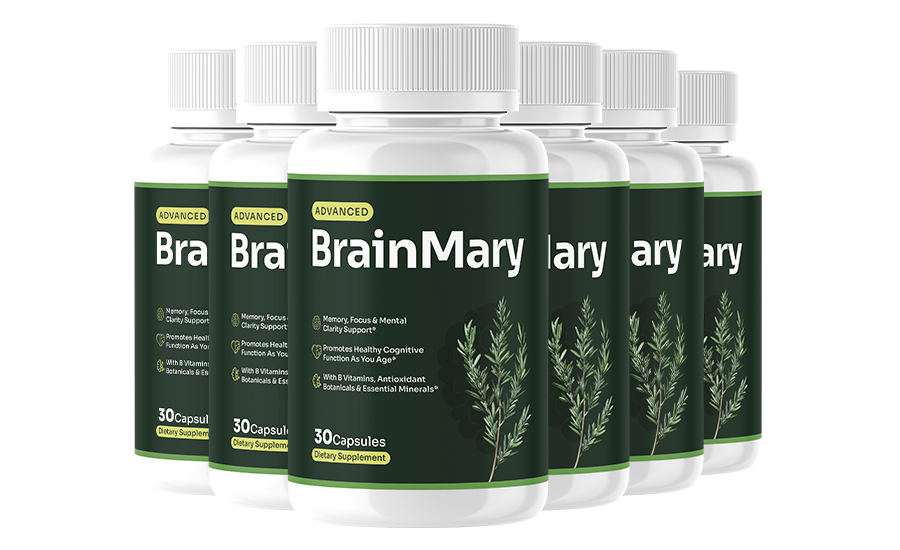

BrainMary is marketed as a once-daily capsule for memory, focus, and mental clarity. We checked it directly across the websites currently selling it and found something the ads don't mention: the ingredient list isn't the same from site to site. One live BrainMary storefront lists botanical fiber and a polyamine compound with no caffeine in sight; a separate BrainMary-branded page our sister publication reviewed lists a different set built around bacopa and ginkgo, plus an undisclosed amount of caffeine from green coffee bean extract; and independent reviewers checking a third BrainMary-branded page found a formula leaning toward caffeine-adjacent stimulants instead. On top of that, we found a documented fake celebrity endorsement, disease-cure marketing claims, and real customer billing complaints tied to this product name. Here's everything we verified.
Individual BrainMary-branded sites make their own claims about memory, focus, recall, and mental clarity. Because we can't confirm which formula would actually ship for any given order, we're not asserting a specific benefit claim of our own here. What follows is what we could independently verify about the ingredients, the marketing, the company behind the name, and the buying process.
We link to one real Amazon alternative and may earn a commission from qualifying purchases at no extra cost to youWe're not linking to any storefront selling BrainMary. Here's why: we confirmed three genuinely different ingredient formulas circulating under this identical name, none with individually disclosed dosages; no site names a manufacturer with a findable street address; independent reviewers documented a fake Bill Gates endorsement and a false claim of a "60 Minutes" feature tied specifically to this product; other independent reviewers and a real customer complaint on Trustpilot describe unexpected or duplicate charges and recurring billing, even though one official BrainMary page's own FAQ states purchases are one-time with no automatic renewals; and one third-party site-trust checker gave BrainMary's selling domain a trust score of roughly 44 out of 100. Rather than send you toward any of those checkouts, we're pointing to a single, standardized-dose version of a well-researched memory-support botanical instead of trying to replicate a BrainMary formula that isn't even consistent from site to site.
See Bacopa Monnieri Extract on Amazon → As an Amazon Associate, we earn from qualifying purchases.BrainMary is marketed as a once-daily capsule supporting memory, focus, and mental clarity. That much is consistent across the versions of it we found. What isn't consistent is what's actually supposed to be inside the capsule, or what the surrounding advertising says it can do — see What we found and The label, in more detail, further down, for what we could and couldn't confirm.
The live product page at brainmary.net, which we checked directly, lists Baobab Fiber, L-Arabinose, Spermidine, and Konjac Glucomannan — none of which are the botanicals typically associated with cognitive-support marketing, and none with a stated milligram amount. Our sister publication, Living Well Reports, independently researched a differently-hosted BrainMary product page and found a completely different formula: Bacopa Monnieri, Ginkgo Biloba, Phosphatidylserine Complex, Huperzine-A, N-Acetyl L-Carnitine, Green Coffee Bean Extract, and B-Complex Vitamins — again, no individual amounts published, and a caffeine source (the green coffee bean extract) that isn't disclosed by dose. A third independent reviewer checking yet another live BrainMary-branded site found a formula built around green coffee bean extract, L-tyrosine, and theobromine — a combination weighted toward caffeine-adjacent stimulants, in contrast to the non-stimulant fiber-and-polyamine formula on brainmary.net. We can't tell you which of these, if any, would actually arrive in a given order, and if you're sensitive to caffeine or already limiting your intake, that's a real reason to pause before ordering from any of them.
An independent review of BrainMary's advertising found a fabricated Bill Gates endorsement — his name and likeness used without his involvement — and a false claim that the product had been featured in a national television newsmagazine segment, neither of which actually happened. The same review documented that BrainMary's surrounding marketing "suggests it can improve memory and even reverse serious conditions like Alzheimer's disease and dementia," concluding there's no reliable evidence supporting that. A separate independent investigation into this category of memory-supplement advertising described the funnel's pitch as leaning on a "villain narrative" — positioning doctors and mainstream medicine as hiding the real answer — a manipulative framing pattern that shows up across a number of similarly-marketed products, not just this one. None of the official BrainMary product pages we checked directly used this language themselves; the disease-cure claims and fake endorsement were documented in the wider advertising and video-funnel ecosystem around the product name, which is a distinction worth understanding rather than a reason to dismiss it.
We directly visited two currently-live BrainMary-branded websites on 2026-09-05: brainmary.net and brainmary.org. A third, us-brainmary.com, returned a "not found" error at the same time — evidence this domain family churns, not just that it's large. Independent research into this product name references at least ten differently-registered domains selling under the BrainMary brand in total. Of the three full ingredient lists we were able to confirm — one from brainmary.net directly, one independently researched by our sister publication, and one documented by another independent reviewer — no two match. That's a meaningfully different situation from a single company simply updating its formula over time; these are live, currently-active pages describing different ingredients under the identical product name at the same time.
The pricing tiers we found were broadly consistent: $79 for a 2-bottle order, $69 per bottle at 3 bottles with free shipping, and $49 per bottle at 6 bottles with free shipping — brainmary.org's own live page headlines that same $49-per-bottle figure as its top offer. Where things diverge is billing. One official BrainMary page's FAQ explicitly states purchases are a one-time order with no automatic renewals or surprise charges. That claim conflicts directly with what independent reviewers and at least one real customer have reported: a Trustpilot review describes being charged for two separate orders totaling $900 while receiving only one shipment, and waiting three months for a promised partial refund that never arrived. Multiple independent reviews of this product category separately describe recurring billing or continuity charges "buried in fine print" at checkout. We can't confirm which experience — the official one-time-order claim, or the reported recurring-charge pattern — applies to any specific order, which is exactly why we're not sending readers to a BrainMary checkout to find out.
The official product pages we checked directly don't use that language. But an independent review of BrainMary's wider advertising found marketing that "suggests it can improve memory and even reverse serious conditions like Alzheimer's disease and dementia," and concluded there's no reliable evidence for that. No dietary supplement, including this one, is a treatment for Alzheimer's disease or dementia, and advertising that suggests otherwise shouldn't be trusted regardless of where it appears.
We can't confirm that it is. One official page's FAQ states exactly that, but independent reviewers and a real Trustpilot complaint describe unexpected duplicate charges and recurring billing tied to this product name — including a $900 charge across two orders for a customer who reported intending to order once. Whichever storefront you're looking at, that's a real conflict worth resolving with the seller, in writing, before you enter payment details.
No. We confirmed three genuinely different ingredient lists across the BrainMary-branded pages we and our sister publication checked — one built around botanical fiber and a polyamine compound with no caffeine, one built around bacopa and ginkgo with an undisclosed amount of caffeine, and one leaning toward caffeine-adjacent stimulants. None of the three matches either of the others.
One website-trust checker scored BrainMary's selling domain at roughly 44 out of 100, flagging it as a comparatively new, low-trust domain. A low score like this partly reflects a domain's age and traffic history, not proof of fraud by itself — but combined with the inconsistent ingredient lists, the documented fake endorsement, and the billing complaints above, it's one more data point pointing the same direction. Separately, BrainMary's page on Trustpilot — a different kind of rating, based on actual customer reviews rather than a domain-safety score — sits at 2.9 out of 5 from a small number of reviews.
Independently documented, yes. A review specifically investigating BrainMary's advertising found a fabricated Bill Gates endorsement using his name and image without his involvement, plus a false claim that the product was featured in a national television newsmagazine segment. Neither happened. This fits a broader pattern independent fact-checkers, including Snopes, have documented across a number of differently-named memory and "brain" supplements using fabricated celebrity endorsements to sell disease-related claims.
It depends which site you order from. We confirmed three different ingredient lists sold under the identical product name: one with Baobab Fiber, L-Arabinose, Spermidine, and Konjac Glucomannan; one with Bacopa Monnieri, Ginkgo Biloba, Phosphatidylserine Complex, Huperzine-A, N-Acetyl L-Carnitine, Green Coffee Bean Extract, and B-Complex Vitamins; and one built around green coffee bean extract, L-tyrosine, and theobromine. None discloses individual per-ingredient amounts. If a listing you're looking at doesn't match one of these three exactly, treat it as a fourth, unverified formula.
We can't say for certain, but the pattern we found — the identical product name spread across at least ten differently-registered domains, with genuinely different ingredient lists and at least one domain (us-brainmary.com) already offline — is consistent with a template-based affiliate or reseller network rather than one single company running one storefront with one formula.
We didn't independently test the finished product, and some individual ingredients used across its various formulas — bacopa monnieri and ginkgo biloba among them — are real, studied botanicals. But we also found three inconsistent ingredient lists under one name, no verifiable manufacturer address, a documented fake Bill Gates endorsement, disease-cure marketing claims in the product's wider advertising, real customer billing complaints, and a third-party trust score of roughly 44 out of 100 for its selling domain. Taken together, that's enough that we chose not to send readers to any specific BrainMary storefront.
Because we couldn't verify one consistent formula or one consistent manufacturer behind the name, because independent reviewers documented a fake celebrity endorsement and disease-cure ad claims tied to this product, and because real customers have reported billing charges that conflict with the "one-time order" claim on at least one official BrainMary page. Instead, we're pointing to a standardized, individually-dosed bacopa monnieri extract on Amazon — a well-researched memory-support botanical with a disclosed dose, rather than a BrainMary formula that isn't even consistent from site to site.
BrainMary isn't one product with one label — it's a name used across at least ten differently-registered websites we found, describing at least three genuinely different ingredient formulas, none of which discloses individual per-ingredient dosages or a verifiable manufacturer street address. One official BrainMary page's own FAQ claims billing is a one-time charge with no surprise fees; independent reviewers and a real Trustpilot complaint describe the opposite, including a reported $900 charge across two orders. Independent reviewers also documented a fabricated Bill Gates endorsement, a false claim of national TV coverage, and disease-cure marketing language connecting the product to Alzheimer's and dementia — none of which any dietary supplement can honestly claim. A third-party site checker put BrainMary's selling domain's trust score at roughly 44 out of 100.
None of that means every ingredient that shows up across BrainMary's various formulas is worthless — bacopa monnieri and ginkgo biloba, which appear in one of the three versions we found, are both real, studied botanicals. But given the inconsistent formulas, the missing manufacturer address, the documented fake endorsement, the disease-cure ad claims, and the real billing complaints, we're not linking to any storefront selling BrainMary. If it's a well-researched, individually-dosed memory-support botanical you're after, a standardized bacopa monnieri extract is the more verifiable way to try one.
See Bacopa Monnieri Extract on Amazon →As an Amazon Associate, we earn from qualifying purchases.
Real labels. Real ingredients. Real reviews.